
How to Measure Your Ring Size Accurately at Home
Determining your ring size is easier than you think! You can find your correct ring size by measuring the circumference of your finger or by using a ring that already fits well. The most important thing is to get an accurate measurement to ensure your new ring fits perfectly and feels comfortable.
Getting the right ring size prevents the frustration of a ring that’s too loose or too tight. It saves you time and money on potential resizing. We’ve researched the best methods to help you find your perfect fit with confidence.
- Measure your finger’s circumference.
- Use a sizer tool for best results.
- Compare to a sizing chart.
- Consider finger swelling.
Below, we’ll walk you through the simple steps to determine your ring size accurately at home. You’ll be ready to shop for your perfect ring in no time!
Finding Your Perfect Ring Size
So, you’ve found the ring of your dreams, or perhaps you’re planning a surprise and want everything to be just right. The most vital step is ensuring it fits perfectly. A ring that’s too loose might slip off unexpectedly, and one that’s too tight can be uncomfortable or even cut off circulation. We’ve researched the best ways to help you measure your finger accurately at home.
Let’s dive into the simple methods that will help you avoid the headache of resizing later.
Method 1: Measuring Your Finger Circumference
This is the most common and straightforward way to find your ring size. You’ll need a few simple household items to get this done. Remember, precision is key for a comfortable fit!
What You’ll Need
Grab these things before you start:
- A flexible measuring tape (like one for sewing) or a strip of paper (about 1/2 inch wide and 4-6 inches long).
- A pen or pencil.
- A ruler or measuring tape for your paper strip.
- A ring size chart (we’ll cover this later).
Step-by-Step Guide
Follow these steps carefully to get the best measurement:
Using a Measuring Tape
1. Wrap the tape snugly around the base of the finger you plan to wear the ring on. Make sure it’s not too tight or too loose. You want it to feel like a comfortable ring fit.
2. Note the measurement where the tape overlaps. This is the circumference of your finger in inches or millimeters. Be precise!
Using a Paper Strip
1. Wrap the paper strip snugly around the base of your finger. Again, aim for that comfortable ring feel – not too tight, not too loose.
2. Mark the paper with your pen or pencil exactly where the paper overlaps. This marks the circumference.
3. Lay the paper strip flat and measure the distance from the end of the strip to your mark using a ruler. This is your finger’s circumference.
Now that you have your finger’s circumference, you’re ready to convert it into a ring size. Many jewelry stores and online retailers use standard US sizing. A common guideline is that each ring size corresponds to a specific circumference. For instance, a size 7 typically has a circumference of about 54.4 mm, and a size 8 is around 57.0 mm (American Jewelry Association).
Method 2: Using a Ring You Already Own
If you have a ring that already fits one of your fingers perfectly, you can use it as a guide. This method is often the easiest and most accurate, provided the ring fits the intended finger well.
What You’ll Need
Gather these items:
- The well-fitting ring.
- A ruler with millimeter markings (essential for accuracy).
- A ring size chart.
Step-by-Step Guide
Here’s how to use your existing ring:
Measure the Inner Diameter
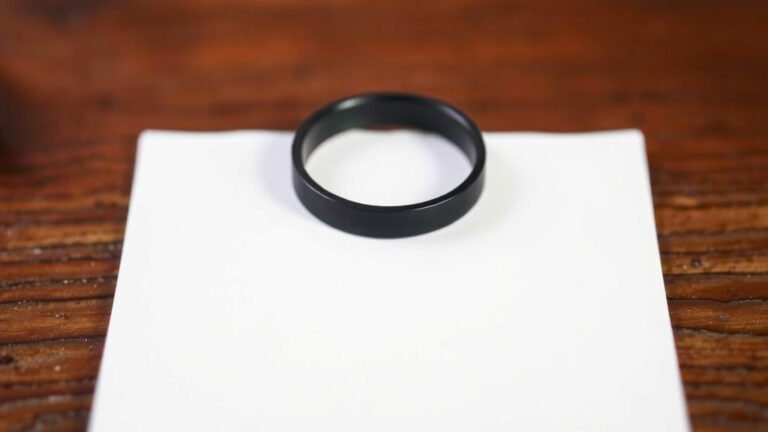
1. Place the ring on a flat surface. Make sure it lies flat and doesn’t wobble.
2. Use your ruler to measure the inner diameter of the ring. Measure across the widest part of the inside of the ring, from edge to edge. Be sure you’re measuring the inside, not the outside, as this is what determines the fit on your finger.
Measure the Inner Circumference (Optional but Accurate)
1. Carefully insert a thin strip of paper or a string into the ring. Make sure it follows the inside curve of the ring snugly.
2. Mark the paper or string where it meets the starting point inside the ring.
3. Remove the paper/string and measure its length with your ruler. This gives you the inner circumference of the ring.
Once you have your measurement (either diameter or circumference), you can compare it to a ring size chart to find your corresponding ring size. Measuring the inner diameter is often quicker, but the inner circumference can provide an equally accurate result if done carefully.
Using a Ring Sizer Tool for Best Results
While paper strips and existing rings can work, the most accurate way to determine your ring size is by using a proper ring sizer tool. These are inexpensive and readily available online or at most jewelry stores. They are designed specifically for this purpose and offer a very precise measurement.
Types of Ring Sizer Tools
You’ll typically find two main types:
- Plastic Ring Sizers: These look like a small belt or a series of nested rings. You slide the plastic strip onto your finger until it’s snug, or you try on the nested rings until you find the one that slides on and off comfortably.
- Finger Gauge Sizers: These are often metal rings with a graduated sizing system. You slip them onto your finger to find the size that fits best.
Many experts recommend using a plastic sizer belt because it mimics the feel of a ring, helping you gauge the fit more realistically. It’s a small investment that can save you a lot of hassle.
Consulting a Ring Size Chart
Once you have your finger’s circumference or the inner diameter of a well-fitting ring, you’ll need a ring size chart. These charts are available online from most jewelry retailers and reputable sources. They translate your measurement into the standard ring size number used in the US and other regions.
Here’s a simplified example of what you might see:
| Ring Size | Inner Diameter (in.) | Inner Circumference (in.) | Inner Diameter (mm) | Inner Circumference (mm) |
|---|---|---|---|---|
| 5 | 0.614 | 1.929 | 15.6 | 49.1 |
| 6 | 0.653 | 2.051 | 16.6 | 51.7 |
| 7 | 0.692 | 2.173 | 17.5 | 54.4 |
| 8 | 0.731 | 2.295 | 18.5 | 57.0 |
| 9 | 0.770 | 2.417 | 19.5 | 59.6 |
| 10 | 0.809 | 2.539 | 20.5 | 62.3 |
Note: This table provides approximate values. Always refer to a specific retailer’s chart for the most accurate sizing.
How to use it: Find your measured circumference or diameter on the chart and see what ring size corresponds to it. Remember that half sizes are common and can make a big difference in comfort.
Important Considerations for Accurate Sizing
Several factors can influence your finger size throughout the day and over time. Taking these into account will help you make the most accurate choice.
Time of Day and Temperature
Did you know your fingers can swell? They tend to be larger when you’re hot and smaller when you’re cold. Many experts suggest measuring your fingers at the end of the day, as this is often when they are at their largest (American Academy of Dermatology Association). Avoid measuring when your hands are cold, as this can lead to an inaccurate, smaller reading.
Finger Swelling and Health
Your fingers might also swell due to various reasons like pregnancy, certain medications, or even high salt intake. If you are pregnant or experiencing significant body changes, it might be wise to wait until after these changes stabilize to get your most accurate ring size.
Width of the Ring
Wider bands tend to fit more snugly than thin bands. If you’re ordering a ring that’s 6mm or wider, you might need to go up a quarter to a half size larger than your usual size. This is because a wider band covers more of your finger, requiring more space.
Knuckle Size
Make sure the ring you are sizing for can pass comfortably over your knuckle. Sometimes, a finger might be larger at the knuckle than at the base. If your knuckle is significantly larger, ensure your measurement accounts for this. The paper strip method, especially if you wrap it around the knuckle, can help account for this.
Which Finger Are You Sizing?
Remember that your fingers on your dominant hand are usually slightly larger than those on your non-dominant hand. Also, the size can vary between fingers on the same hand! Always measure the specific finger you intend to wear the ring on.
Your Ring Sizing Checklist
To recap, here’s a quick checklist to ensure you get the perfect fit:
- Measure your finger when it’s at a normal temperature, not too hot or cold.
- Measure at the end of the day, as fingers tend to be largest then.
- Use a flexible measuring tape, paper strip, or a proper ring sizer tool.
- Ensure your measurement is snug but comfortable, mimicking a ring’s feel.
- Compare your measurement to a reliable ring size chart.
- Consider the width of the ring band for a more accurate fit.
Conclusion
You’ve learned how to accurately measure your ring size right at home! Whether you use a simple paper strip, a ring you already own, or a specialized sizer tool, the key is careful measurement. Remember to consider factors like the time of day, temperature, and the ring’s band width for the most comfortable fit. With these methods, you’re well-equipped to confidently select rings that feel perfect on your finger. Now you can shop for that special piece of jewelry with confidence and avoid any sizing surprises!
Frequently Asked Questions
How do I know if my ring is too tight or too loose?
A ring that’s too tight will feel uncomfortable, may leave marks on your finger, or even restrict circulation. A ring that’s too loose might slide around easily, feel insecure, or even risk falling off.
Can I measure my ring size while my fingers are swollen?
It’s best to avoid measuring when your fingers are swollen from heat, salty foods, or medical reasons. Measure when your fingers are at a more normal size, ideally at the end of the day when they tend to be largest.
Does the width of the ring affect my ring size?
Yes, wider bands tend to fit more snugly. If you’re choosing a ring that’s 6mm or wider, you might want to go up a quarter to a half size larger than you normally would.
Why are my fingers different sizes on each hand?
Your dominant hand’s fingers are often slightly larger than those on your non-dominant hand. It’s also common for the size to vary between fingers on the same hand, so always measure the specific finger where you’ll wear the ring.
What’s the best way to measure if I’m buying a ring as a surprise gift?
If you can’t measure their finger directly, try borrowing a ring they wear on the correct finger and measuring its inner diameter or circumference. Alternatively, trace the inside of their ring or ask a close friend or family member if they know the size.